Factoring is when a staffing agency sells its unpaid client invoices to a factoring company for immediate cash, rather than waiting for the client's standard payment terms to play out.

September 16, 2026
Staffing Factoring: How Agencies Turn Unpaid Invoices Into Cash

By advancing 80 to 95% of an invoice's value upfront, staffing factoring bridges the cash flow gap for agencies that must handle weekly payroll while waiting 30 to 90 days for client payments. This solution offers immediate working capital without the burden of new debt.
Staffing factoring is a financing solution that allows staffing agencies to sell their unpaid invoices to a factoring company in exchange for immediate cash, rather than waiting 30 to 90 days for client payments. The factoring company advances most of the invoice amount upfront and releases the remaining balance, minus a small factoring fee, once the client pays in full.
For staffing agencies and staffing companies covering weekly payroll long before client payments land, that gap is exactly where staffing factoring does its work. We’ve heard this problem countless times across different staffing agencies at Meritus Capital.
This guide covers how staffing factoring works, how it compares to bank loans and payroll funding, who qualifies, what it typically costs, and how to choose the right factoring company for your agency.
What Is Staffing Factoring?
Staffing factoring, also referred to as invoice factoring for staffing agencies, provides a mechanism for staffing companies to exchange their unpaid invoices for working capital without incurring new debt.
Rather than borrowing against future earnings like a standard loan, factoring involves selling the invoice as an asset at a discount to secure rapid, immediate cash flow.
Because of the way payroll obligations are structured, this distinction is particularly vital for the staffing sector. Staffing agencies typically pay their personnel weekly, whereas clients often take 30 to 90 days to settle invoices.
A staffing factoring firm closes this cash flow gap by providing immediate capital against outstanding invoices, ensuring that payroll is never delayed by a client's billing cycle.
A reputable factoring company will not act as a lender, bank, or mortgage provider. It’s a funding partner focused specifically on turning accounts receivable into immediate working capital, with agreements built around how staffing firms actually operate.
Why Staffing Agencies Need Factoring
Staffing agencies typically run on narrow profit margins, compounded by substantial operational costs and payroll taxes on top of weekly employee earnings. Consequently, even minor delays in client payments can lead to significant financial friction, particularly when a business is expanding quickly.
Staffing factoring automatically scales with business growth as invoice volume increases, which makes it a strategic growth tool rather than a short-term patch. As an agency adds new contracts and staffing operations expand, factoring capacity typically grows in step with invoice volume, without requiring a new loan application each time.
How Staffing Factoring Works
The factoring process follows a consistent structure, whether an agency is factoring a single invoice or its entire book of receivables.
Step 1: Submit the Invoice
After completing a shift or contract term, the staffing agency submits the client invoice to its factoring company rather than waiting until the client's standard payment terms expire.
Step 2: Receive the Advance
Upon reviewing the invoice, the factoring company provides a significant percentage of its total value upfront, frequently within a 24- to 48-hour window. Staffing agencies generally receive an initial advance ranging from 80% to 95% of the invoice amount, although the exact rate depends on the provider and the client's creditworthiness.
Step 3: The Client Pays the Factor
The client pays the invoice under its normal terms but sends payment directly to the factoring company rather than to the staffing agency. This is the step where the customer pays, which closes out the transaction on the client's end.
Step 4: Get the Rebate
Upon receiving the client's full payment, the factoring provider transfers the remaining funds to the staffing firm after deducting its standard fee. Depending on specific agreement terms, invoice amounts, and how quickly clients settle their bills, typical factoring fees across the industry range from 1% to 5% per invoice.
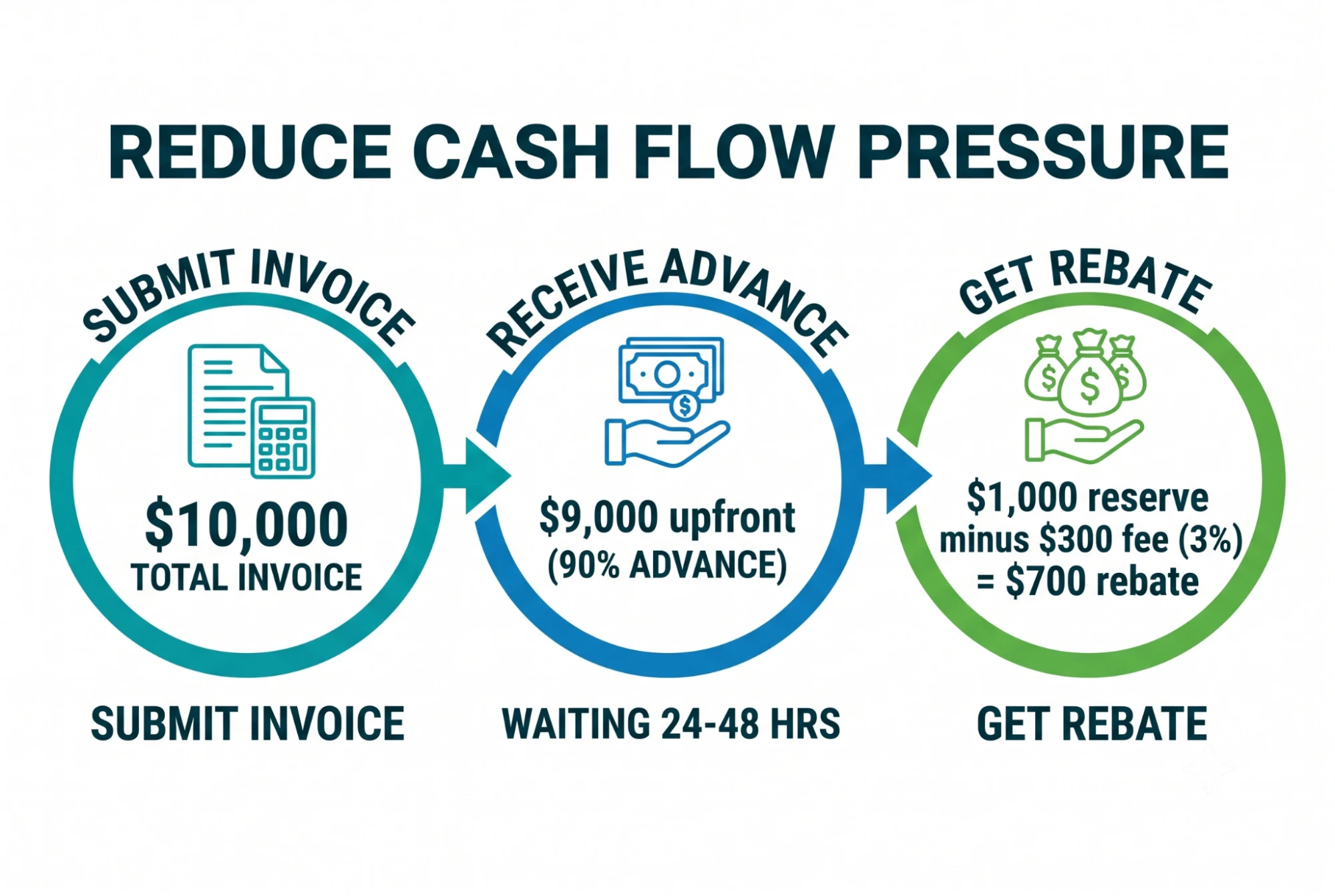
Image Source: Gemini 2026
This cycle repeats with each new invoice, which is why many staffing companies treat invoice factoring as an ongoing cash flow strategy rather than a one-time transaction.
Staffing Factoring vs. Bank Loans
Staffing factoring advances cash against invoices a client already owes; a bank loan lends against the agency's own credit and adds it to the balance sheet as debt.
Staffing agencies exploring financial solutions often compare factoring against traditional bank loans, and the table below shows where the two diverge.
This structure lets staffing agencies pursue new contracts with confidence, without incurring additional debt.
Who Qualifies for Staffing Factoring
Most staffing agencies can qualify for factoring services, regardless of how long they’ve been in business. Because factoring approval hinges on client creditworthiness rather than agency credit, even newer staffing firms with limited financial history can typically access funding.
The core requirement is straightforward: agencies must have invoices for completed work in order to qualify. Beyond that, factoring companies generally look at the mix and reliability of an agency's client base rather than the agency's own financials, which is part of why factoring has become such an accessible option across the staffing industry.
Who Uses Staffing Factoring
Staffing factoring is most common in segments of the staffing industry where payroll obligations are frequent, margins are thin, and client payments are slow. That combination puts constant pressure on cash flow, even for well-run, profitable staffing companies.
Healthcare Staffing Factoring
Healthcare staffing agencies place nurses, allied health professionals, and other clinical staff with hospitals and health systems that are reliable payers, but slow ones. Medical staffing factoring companies help these agencies bridge the gap created by delayed client payments and the upfront costs of credentialing and compliance for each placement.
Temp Staffing Factoring
Temporary staffing factoring is common among agencies placing industrial, clerical, and hospitality workers on short-term assignments. Temp staffing factoring becomes especially valuable during periods of seasonal demand or rapid growth, when a single new client contract can mean a sharp jump in weekly payroll before that client's first invoice is even due.
Industrial and Administrative Staffing Factoring
Industrial staffing and recruiting firms that place administrative or light-industrial talent face similar cash-flow fluctuations tied to project-based client work. Staffing agency factoring gives these firms the flexibility to cover weekly payroll and meet payroll obligations even when a handful of key clients pay on extended terms.
What Staffing Factoring Costs
Staffing factoring typically costs 1% to 5% of the invoice value in fees, on top of an 80% to 95% upfront advance, with exact pricing set by the provider and the client's risk profile. Every factoring company structures its pricing slightly differently, but the core mechanics remain consistent across the industry.
Factoring Fees Explained
A factoring fee is deducted from the invoice value in exchange for the immediate cash flow the arrangement provides. Industry-standard factoring fees typically range from 1% to 5% per invoice, generally scaling with how quickly the client pays and the volume of invoices the agency processes under the factoring agreement.
Advance Rates Explained
The advance rate determines how much of the invoice value an agency receives upfront before the client pays. As referenced earlier, agencies across the industry can generally expect an 80% to 95% advance, with the remaining balance released once the client settles the invoice in full.
Rather than guess at specific numbers here, since pricing varies by provider and by agency risk profile, it’s worth comparing fee structures directly. For a closer look at how factoring fees are typically calculated, see Comparing Invoice Factoring Fees: A Simple Guide to Finding Your Growth Fuel.
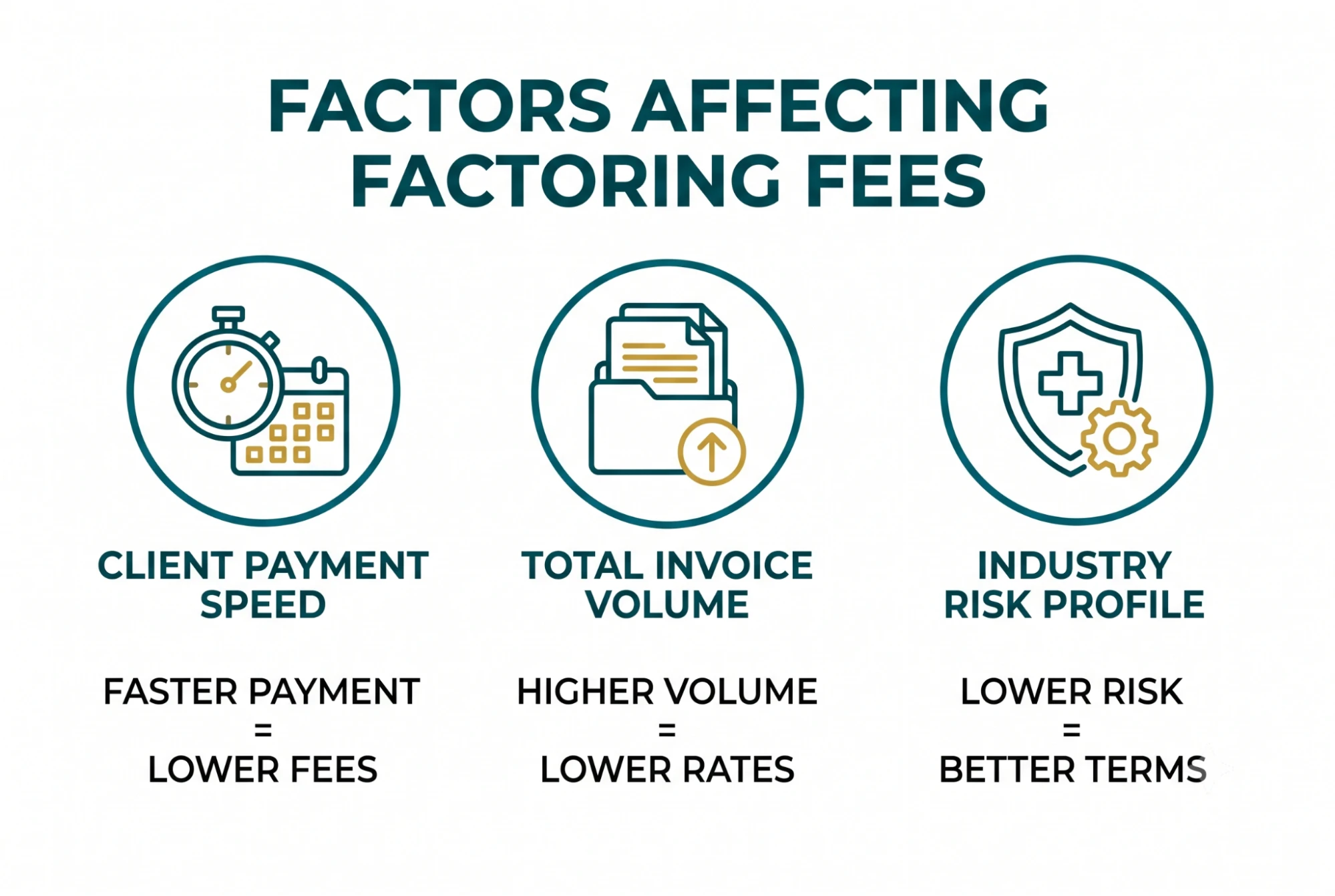
Image Source: Gemini 2026
Staffing Factoring vs. Payroll Funding
Staffing factoring is built around individual invoices an agency chooses to sell, and immediate cash flow is tied directly to those receivables. Meanwhile, payroll funding is typically structured as a broader program that covers payroll obligations across an agency's entire client base, often with greater flexibility in how funds are used.
Neither option is universally better. The right funding partner depends on how an agency bills clients, how consistent payroll obligations are, and how much control the agency wants over which receivables get funded.
For a full breakdown of how payroll funding works and when it makes more sense than invoice-level factoring, see What Is Payroll Funding?
Agencies exploring funding options more broadly can also check our guide to funding for staffing agencies.
How to Choose a Staffing Factoring Company
Not every staffing factoring company is built the same way, and the right funding partner should fit how an agency actually operates, not the other way around. When evaluating factoring companies for staffing agencies, look for:
- Flexible agreements that let agencies choose which invoices to fund, without a minimum volume requirement
- Transparent pricing with no hidden fees buried in the contract
- Fast approvals, so a slow decision doesn't hold up next week's payroll
- Complimentary credit checks on clients, so agencies know who they are extending credit to before committing
- Immediate access to funds and 24/7 account visibility, without waiting on a phone call
- Staffing industry experience, since payroll cadence and client billing differ meaningfully from other B2B sectors
At Meritus Capital, this looks like zero signup fees, no minimums required, and full portal access from day one, all built around a human, collaborative approach rather than a rigid, one-size-fits-all agreement.
FAQs About Factoring for Staffing Companies
Key Takeaways
- Staffing factoring turns unpaid client invoices into immediate cash flow, often within 24 to 48 hours.
- Agencies can receive 80% to 95% of the invoice value upfront, with the remaining balance paid once the client settles.
- Unlike bank loans, factoring approval is based on client creditworthiness, not the staffing agency's own credit or balance sheet.
- Factoring doesn't add debt to your balance sheet since it's a sale of receivables, not a loan.
- Healthcare and temp staffing agencies rely on factoring most of the time, given slow-paying clients and frequent payroll cycles.
- Choosing the right staffing factoring company means comparing fees, advance rates, and contract flexibility, not just speed.
Ready to Put Staffing Factoring to Work?
Slow-paying clients shouldn't set the pace for a staffing agency's growth. Staffing factoring turns outstanding invoices into working capital within days, not months, so payroll, new contracts, and expansion stop waiting on someone else's payment terms.
If your agency is ready to see what staffing factoring could do for its cash flow, get in touch with our team to talk through your options.
More questions? We're here to help.
Send us a note and our team will reach out to you or simply call us at 877-648-3709