Temporary staffing agencies are the most common type, placing workers in short-term or seasonal roles across industries such as manufacturing, logistics, healthcare, and warehousing, while managing weekly payroll for high staff volumes.

August 12, 2026
Types of Staffing Agencies

Staffing agencies include temporary staffing, direct hire, healthcare, staffing logistics, and light industrial, each with unique payroll and placement models. Understanding these distinctions helps businesses select the right partner and enables agency owners to manage cash flow effectively.
Not all types of staffing agencies operate the same way, and that difference matters whether you’re choosing the right staffing partner for a hiring need or an entrepreneur deciding which niche to build a staffing business around.
Some agencies place workers on one shift. Others place a candidate once and step back entirely. Each model comes with its own cash flow rhythm, and understanding it is the first step toward building a staffing business that lasts.
This guide from Meritus Capital outlines the main types of staffing agencies, the services they provide for permanent and temporary employees across industries, and where financial pressures typically arise.
Whether your focus is workforce planning, industry expertise, or finding a partner aligned with your strategic goals, understanding the staffing landscape is essential before committing to a contract.
1. Temporary Staffing Agencies
A temporary staffing agency places workers with a client for a limited stretch, a single shift, a seasonal peak, a short-term project, not a permanent role. The model runs on a fast-repeating cycle: a client calls for coverage, the agency recruits and places workers fast, and then carries the cost of payroll every week until the client’s invoice is paid.
Here’s how that cycle typically plays out:
- A client requests coverage for specific shifts, projects, or seasonal spikes.
- The agency recruits and vets candidates, often placing them within a few days.
- The agency pays temporary workers weekly, no matter when the client settles up.
- The agency invoices the client on net terms, and that payment can take 30, 45, or even 60 days to land.
That gap, paying workers every week while waiting on client payment, is the defining challenge of temporary staffing. High volume and tight margins mean payroll must be met on time, every time, whether or not the client’s payment has cleared.
The Payroll Gap, Solved
This is exactly the problem Meritus Capital's payroll funding was built to solve. Instead of waiting weeks for client payments to clear, a temporary staffing agency can fund payroll against its outstanding invoices and keep cash moving every single week.
That means two things: a business hiring a temp agency gets a partner far less likely to hit a cash crunch mid-project, even during a sudden hiring surge. And for anyone building a staffing business, recruiting skills alone don’t determine whether a temp agency scales; consistent access to payroll cash does.
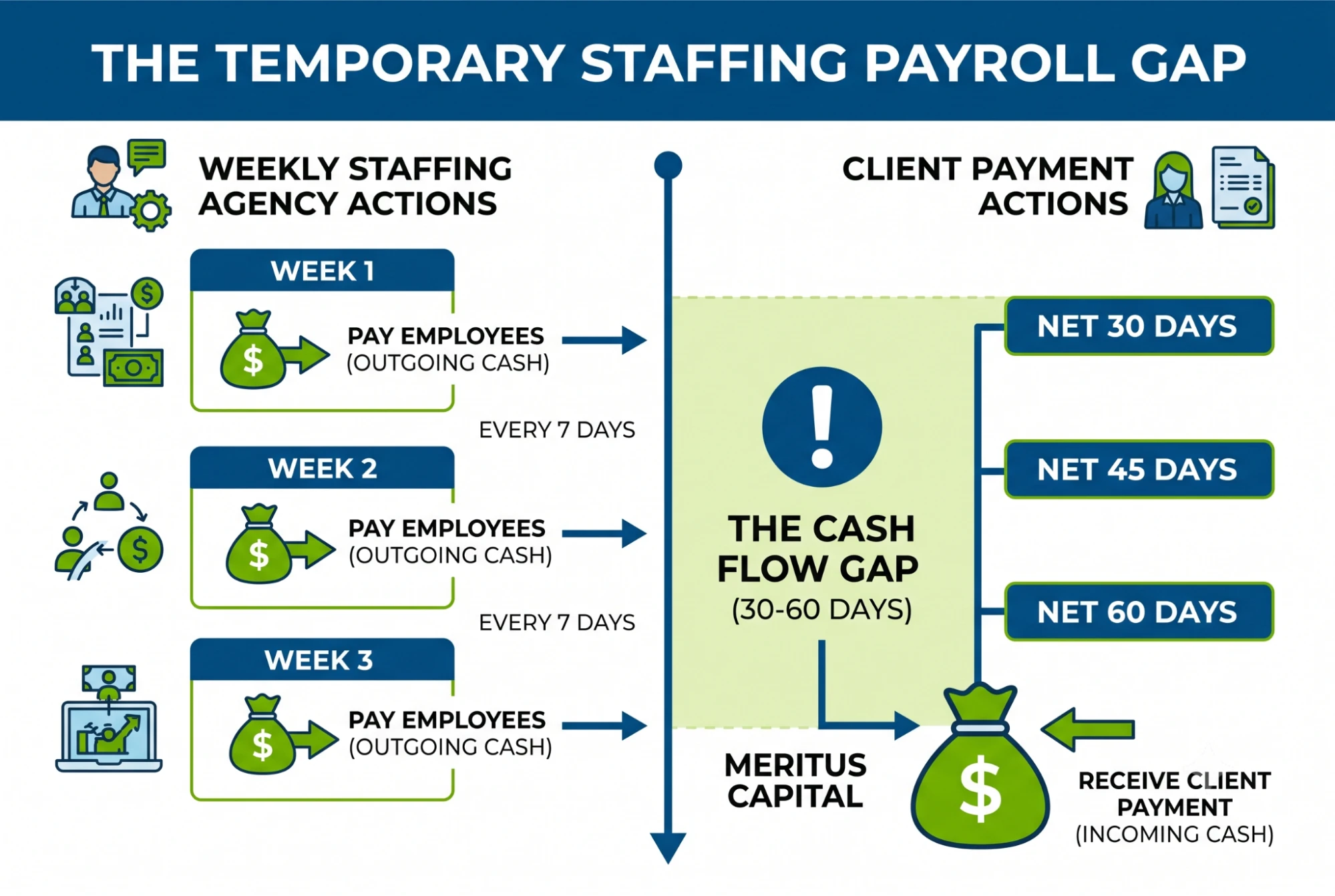
Image Source: Gemini 2026
One agency proved it. A direct-hire firm that expanded into temporary staffing used payroll funding to manage the new weekly payroll cadence and grew 13x in its new division, growth that would’ve been hard to sustain without steady cash for payroll.
It’s a useful signal either way. For a business, it shows a well-funded partner can handle demand spikes. For a future agency owner, it shows what’s possible once the cash flow problem is solved early.
2. Direct Hire and Permanent Placement Agencies
A direct hire agency, also called permanent placement or permanent recruitment, places a candidate into a client's permanent role and earns a one-time placement fee rather than ongoing payroll, typically 15 to 25 percent of the candidate's first-year salary.
Once the agency places a candidate, its payroll exposure ends there. The new hire becomes the client's employee, not the agency's. The agency's job is to source, screen, and confirm the right fit. Once that's done, the work is done.
On the surface, it appears to be the simpler model. The catch is timing.
Placement fees don't land the moment a candidate signs. Invoices are issued on net terms, and payments may take 30 to 90 days to be received. For a direct hire staffing agency covering overhead and recruiting costs in the meantime, that lag creates its own cash crunch, just a slower-moving one.
It's a real gap, and it's one reason many direct-hire agencies eventually build a second line of business with more predictable cash flow. Permanent placement often sits atop a payroll-funded temp division, and it works well precisely because the temp side generates recurring receivables that direct hire alone doesn't. See how that transition plays out in our breakdown of the move from direct-hire recruitment to temp and contract staffing.
Whichever model an agency runs, the financing terms behind it matter as much as the placements themselves. One staffing company generating $30 million a year cut financing costs by over $100,000 within 12 months by switching to a lower-fee, more transparent funding partner. Capital went straight back into growth instead of disappearing into fees.
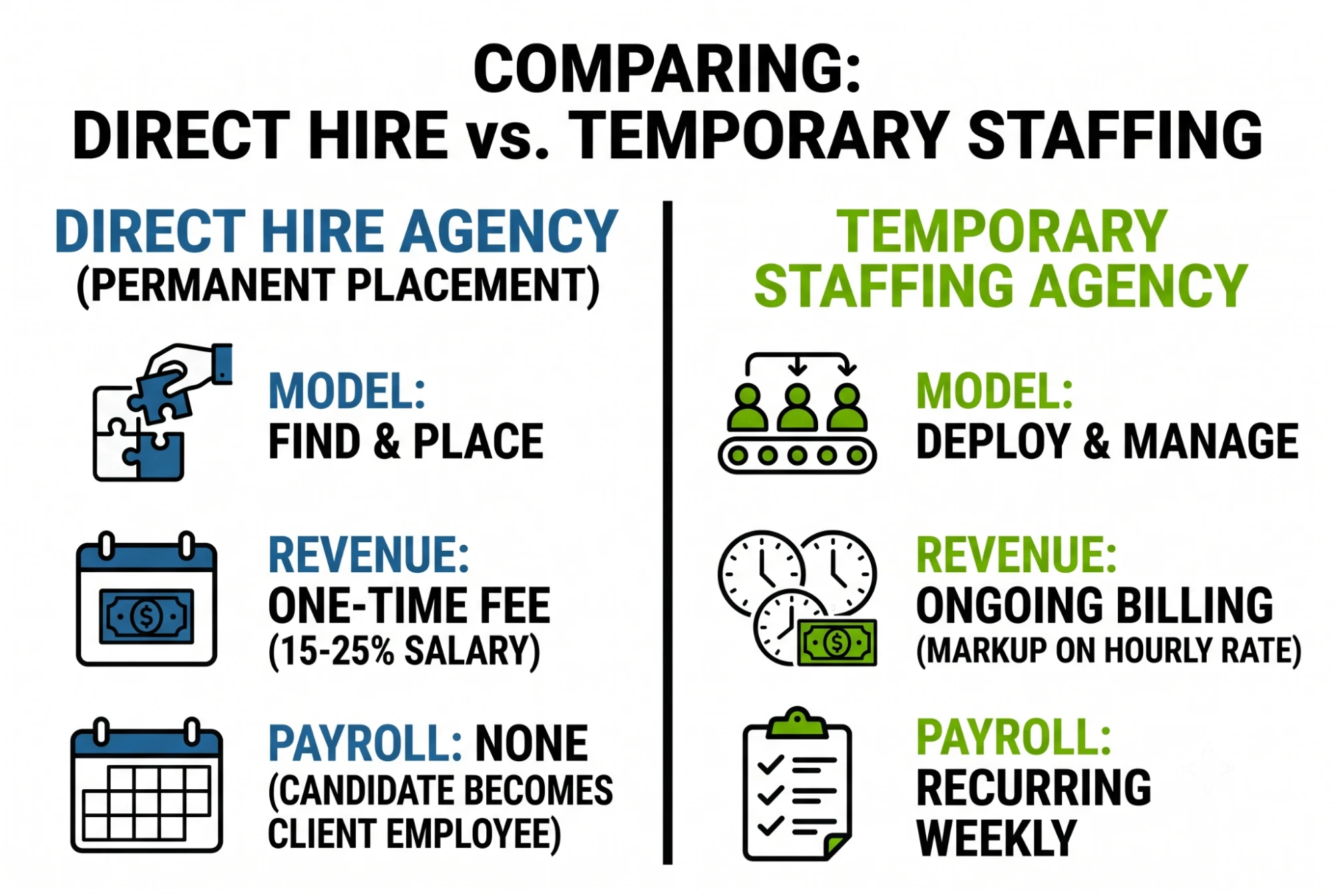
Image Source: Gemini 2026
3. Staffing Logistics Companies
A staffing logistics company places high volumes of workers into warehousing, supply chain, and distribution roles: truck drivers, freight handlers, seasonal fulfillment staff, the kind of work a logistics or transportation staffing agency typically handles. Demand spikes hard around seasonal peaks, fulfillment surges, or rapid contract ramp-ups.
The payroll exposure here is serious. When a client needs hundreds of workers staffed across multiple shifts during a peak period, the agency fronts payroll for all of them, while client payment terms stay exactly the same, spike or no spike.
This is where advance rates stop being a nice-to-have and become the whole game. One logistics staffing agency scaled to $36 million in additional annual sales and needed advance rates above 93% to sustain that growth. Without that level of funding against outstanding invoices, rapid growth would have created payroll obligations that no agency could keep up with.
From first invoice to full-scale growth, we fund the journey. That’s the model Meritus built specifically for logistics and transportation staffing agencies, because growth at this scale can’t wait on net-60 terms while payroll goes out every week.
Many of these agencies also work under strict safety standards set by clients and groups like the National Safety Council. A steady cash position helps fund the training, equipment, and safety compliance those standards require.
4. Light Industrial Staffing Agencies
A light industrial staffing agency places workers into manufacturing, warehouse, assembly, and distribution roles, the territory a manufacturing staffing agency typically covers. Production line workers, assembly line staff, pickers, packers, and general warehouse labor all fall under this umbrella.
The cash flow challenge mirrors temporary staffing almost exactly. Workers get paid weekly. Clients pay on net terms. The agency fills that gap regardless of how many shifts it covers each week.
Light industrial staffing sits close to manufacturing and transportation, two industries Meritus actively funds, so financing solutions built for payroll-heavy staffing models apply here, too. Agencies in this space also follow strict safety standards on the factory floor, and many specialize in placing workers who already hold the certifications a given facility requires.
The best light industrial agencies invest in safety training and build long-term relationships with the facilities they staff, often on a tight budget, while still keeping plants running efficiently.
5. Healthcare, IT, and Nursing Staffing Agencies
Beyond the models above, several specialized staffing sectors round out the industry, each with its own service quality standards and certification requirements.
Healthcare staffing agencies place clinical and administrative employees in hospitals, clinics, and long-term care facilities, often filling roles that require specific licensing.
IT staffing agencies connect businesses with technology talent, from short-term contract developers to longer-term placements for specialized technical roles.
Nursing staffing agencies focus specifically on placing registered nurses and nursing support staff, frequently covering shift gaps, seasonal demand, or facility-wide shortages.
Across the staffing industry, agencies place millions of workers each year, and industry leaders are routinely rated on service quality (retention, time to fill, and client satisfaction) by groups like the American Staffing Association.
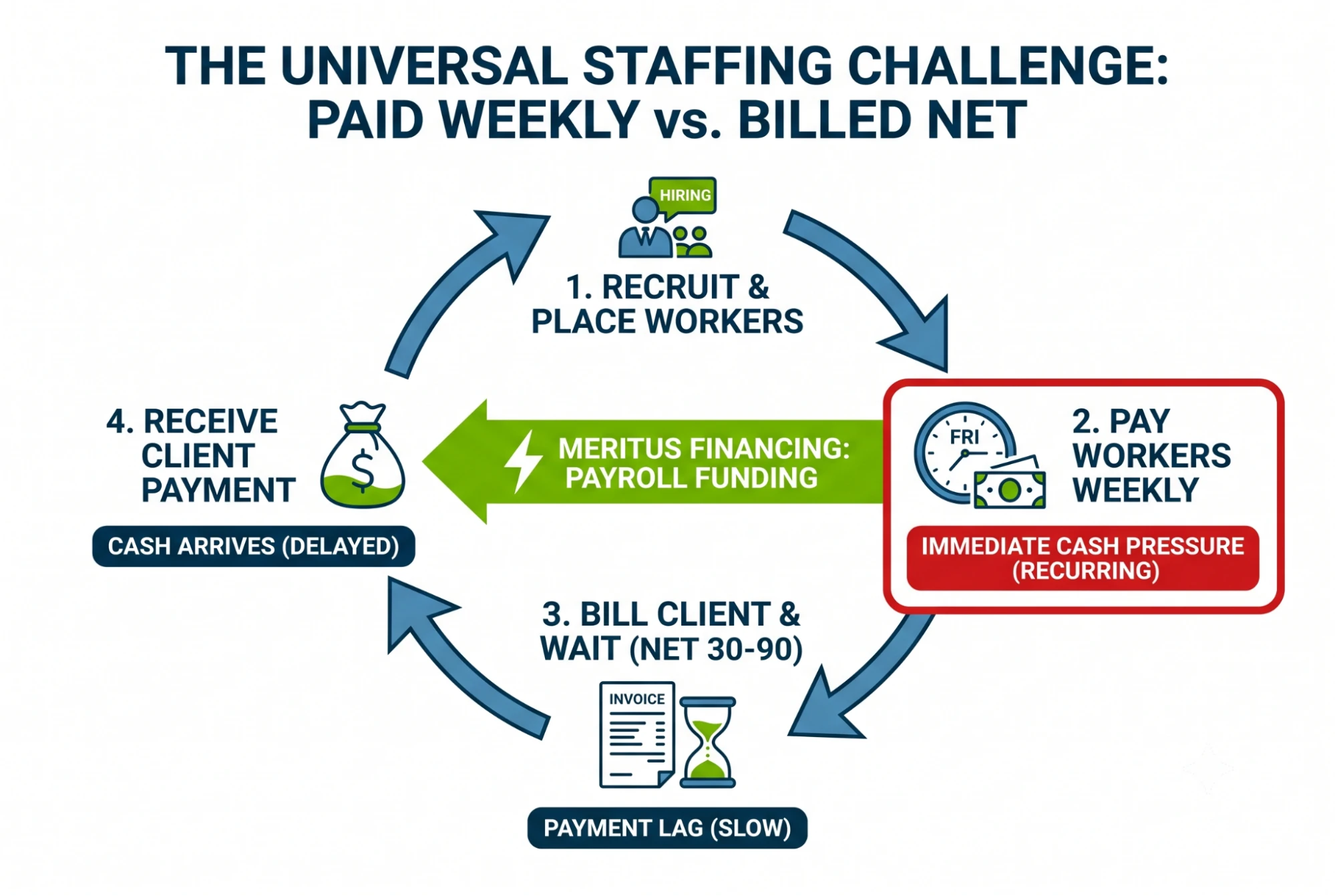
Image Source: Gemini 2026
FAQs About Staffing Solutions
Key Takeaways
- Temporary staffing agencies manage weekly payroll while billing clients on net terms
- Direct hire agencies earn one-time placement fees, typically 15% to 25% of the first-year salary
- Staffing logistics agencies face the highest payroll exposure during peak season demand
- Light industrial staffing agencies share the same weekly payroll challenge as temp staffing agencies
- Invoice factoring and payroll funding bridge the gap between payday and client payment
- Healthcare staffing agencies place clinical and administrative employees, but fall outside direct payroll or factoring products discussed here
- Choosing the right staffing partner depends on the placement model, not just industry fit
Workers Are Paid Weekly. That Gap is Where We Operate.
Across nearly every staffing model, the same pattern shows up. Employees get paid weekly. Clients pay on their own terms, whether that’s net 30, net 60, or a placement fee that lands months after the work is done. That gap between outgoing payroll and incoming payment is where staffing agencies feel the most pressure, and it’s exactly where Meritus operates.
When you’re running a temporary staffing agency and managing weekly payroll, the financing behind your business matters as much as the placements themselves.
Our team brings years of industry knowledge to funding staffing businesses like yours, with instant access to working capital instead of long net terms, support during growth, and the resources to achieve long-term success.
Explore how Meritus supports staffing agencies across the industries we fund, or see how payroll funding works for staffing agencies in more detail.
More questions? We're here to help.
Send us a note and our team will reach out to you or simply call us at 877-648-3709