Staffing agencies cover temporary, contract, and permanent placements and often manage ongoing payroll and HR tasks for placed workers. Recruitment agencies specialize in permanent positions, typically at a higher level, and step back once the hire is made.

July 15, 2026
What Is a Staffing Agency?

A staffing agency connects employers with job seekers for temporary, contract, and permanent roles. Staffing agencies handle recruiting, screening, payroll, and employment taxes, so client companies can fill positions faster and focus on core business activities rather than administrative tasks.
Staffing agencies act as intermediaries between employers and job seekers, handling the full recruitment process so businesses can fill roles faster and workers can find opportunities more efficiently.
Whether you need temporary workers, contract employees, or permanent hires, staffing agencies work to match the right people to the right roles.
The Purpose of a Staffing Agency
A staffing agency connects businesses with qualified candidates. Companies come to them with open positions and specific hiring needs. The agency finds, screens, and places suitable candidates. It saves businesses time, reduces hiring risk, and gives job seekers access to opportunities they might not find through job boards alone.
Staffing agencies work across every industry and every level of hire, from entry-level temporary roles to executive positions. Many staffing agencies maintain extensive databases of pre-screened candidates, allowing them to move quickly when a client has an urgent need.
For job seekers, working with a staffing agency can open doors to unadvertised job opportunities, build experience quickly, and sometimes lead to permanent employment.
What does a staffing company do?
Beyond posting a job description and collecting applications, staffing firms take on the full weight of the hiring process. That includes:
- sourcing candidates through professional networks and job boards
- reviewing resumes
- screening candidates through interviews and skills assessments
- running background checks
- verifying references
- managing onboarding tasks once a placement is confirmed.
Many staffing agencies also provide job seekers with resume assistance and interview preparation, which makes working with a staffing agency valuable on both sides of the equation.
Staffing agencies supported about 13 million job opportunities in 2023, and for some roles, traditional hiring can take roughly 33 to 49 days, so speed is a major part of the value proposition.
Types of Staffing Placements
Not every staffing relationship looks the same. The structure of a placement depends on the employer's staffing needs, the nature of the role, and the duration of the position.
Staffing agencies fill temporary, permanent, and contract positions, and the right staffing agency will help businesses identify which model best fits their needs.
Temporary staffing
Temporary staffing covers short-term arrangements, ranging from a single day to just under a year. A business needs extra hands for a busy season, a project, or to cover an employee's leave. The agency places temporary workers for a defined period, and the employment relationship typically stays with the agency throughout.
Temp agencies are heavily used in manufacturing, warehousing, retail, and logistics, where demand fluctuates, and businesses need flexible staffing solutions to scale up or down quickly. The agency handles payroll, employment taxes, and workers' compensation for those placements, which significantly reduces the administrative burden on the client company.
Contract staffing
Contract staffing involves placing a worker in a role for a set project or defined term. Contract positions are common in technology, engineering, finance, and healthcare, where specialized talent is needed for specific project scopes of work. Contract employees may be employed by the agency or operate independently, depending on the arrangement.
Staffing agencies specialize in contract staffing when the required expertise is narrow or the timeline is project-driven. This model gives businesses access to specialized talent without committing to a permanent hire.
Temp-to-hire
Temp-to-hire is one of the most practical staffing solutions available. The worker starts in a temporary job, and if the fit is right, the client company transitions them into a permanent position. This model lets both the employer and the job candidate assess the working relationship before making a long-term commitment.
Contract-to-hire works similarly, typically for more senior or specialized roles. Both approaches give businesses a lower-risk path to permanent hires, and staffing agencies work closely with both parties to manage the transition.
Direct hire
In a direct hire arrangement, the agency recruits and screens job candidates on behalf of a business, but the worker becomes a full-time employee of that company upon placement. The agency earns a one-time placement fee and steps out of the employment relationship after that.
This model suits companies that want to add permanent positions but lack the internal recruiting capacity to fill them efficiently.
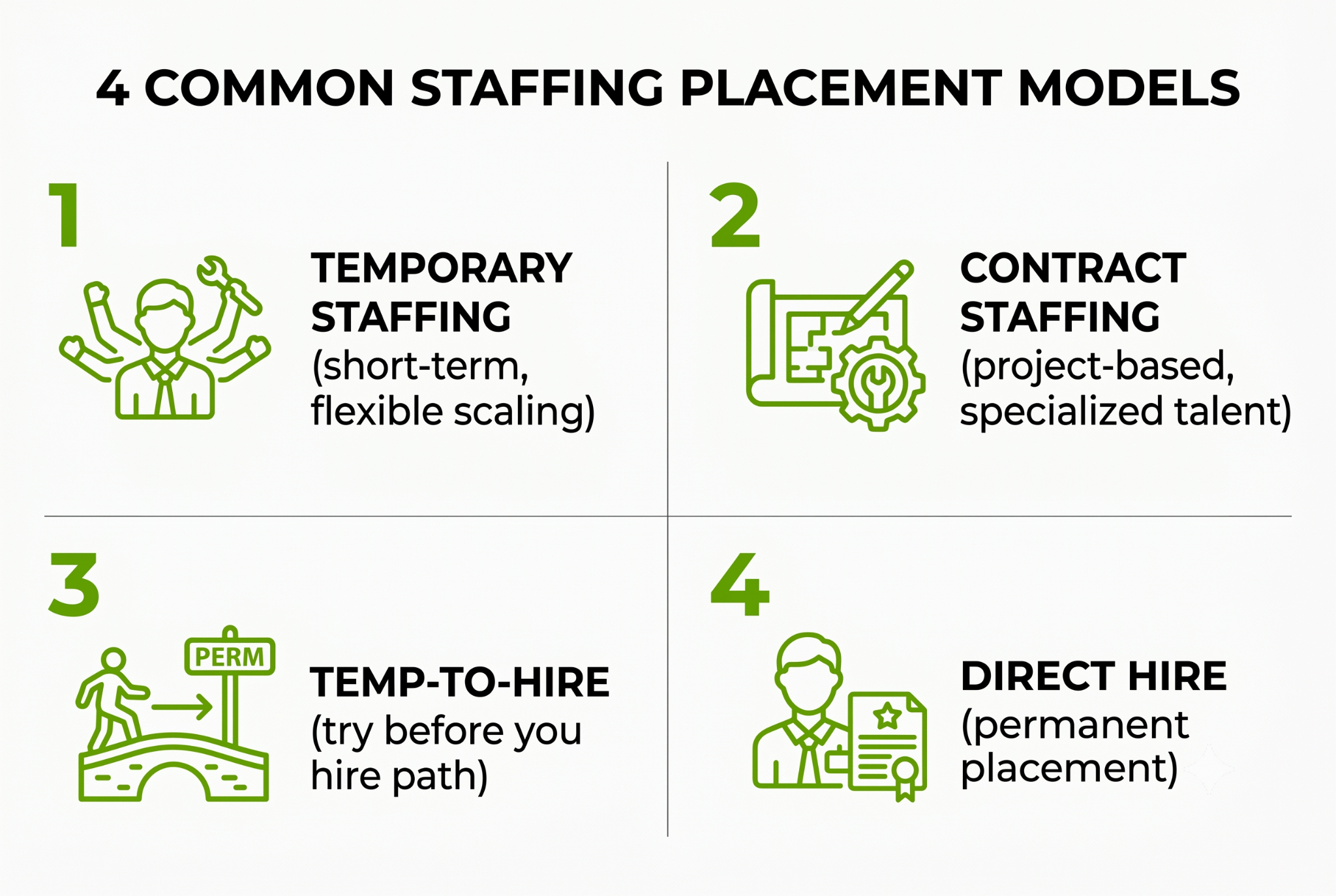
Image Source: Gemini 2026
How Staffing Agencies Charge Fees
Understanding the fee structure matters, both for businesses evaluating staffing services and for anyone trying to understand how the staffing industry works.
Job candidates do not pay fees to staffing agencies. Employers pay fees for the service, and the structure depends on the placement type.
For temporary and contract placements, staffing agencies charge a bill rate to the client company. This rate covers the worker's pay plus a markup. That markup accounts for payroll taxes, workers' compensation, benefits administration, payroll processing, and the agency's margin. Staffing agencies typically charge a markup of 25% to 75% on temporary staffing, depending on the industry and role complexity.
For permanent placements, staffing agencies charge a fee based on a percentage of the candidate's first-year salary. Permanent placement fees generally range from 15% to 30% of the employee's salary. For executive positions and specialized talent searches, retained search firms charge 25% to 35% (up to 38%) and require an upfront retainer fee.
The way employers pay fees is straightforward: the client company pays the agency, the agency handles payroll and taxes for temporary workers, and the business focuses on its core activities rather than administrative tasks.
How Staffing Agencies Work: The Recruitment Process
When a client company brings a staffing agency on board, the recruitment process follows a consistent path.
It starts with understanding the job requirements. The agency and the client work together to build a clear job description, align on company culture fit, and agree on the timeline. From there, the agency taps into its candidate sourcing channels, including its existing database, professional networks, and active job posting campaigns.
Screening candidates is where staffing agencies add significant value. Rather than passing along a stack of resumes, staffing firms deliver pre-screened candidates who have already been vetted for skills, availability, and fit. That reduces the time the client company spends reviewing resumes and conducting early-stage interviews.
Once a match is confirmed, the agency manages the transition into the role, including any onboarding tasks and employment paperwork. For temporary and contract placements, the agency continues to manage employment taxes, payroll processing, and workers' compensation throughout the engagement.
Staffing Agencies by Industry
Staffing agencies specialize across a broad range of sectors. A generalist agency might offer workforce solutions across many industries, while specialized agencies focus on a particular industry and build deep expertise in that talent market.
Common areas where staffing agencies specialize include:
- Light industrial and manufacturing. High-volume temporary staffing for production, assembly, packaging, and warehouse roles. Temp agencies in this sector are built to handle large-scale, fast-moving staffing needs.
- Healthcare. Travel nurses, allied health professionals, and locum physicians. Credentialing and compliance requirements make this one of the more complex areas of the staffing industry.
- Technology. Contract positions for developers, engineers, data analysts, and IT professionals. Project-based staffing solutions are especially common here.
- Finance and accounting. Temporary and permanent placements for accounting, audit, and financial analysis roles, often timed around fiscal year-end or specific projects.
- Administrative and clerical. One of the oldest staffing categories, covering a broader range of office support and customer service roles across nearly every industry.
The Payroll Timing Gap: Why Staffing Agencies Struggle With Cash Flow
Here’s where the staffing business model gets complicated, and it’s important to understand this if you’re running or considering starting a staffing agency.
Staffing agencies pay their temporary workers weekly or biweekly. Workers need their paychecks on a reliable schedule, and that obligation doesn’t flex based on client payment timelines.
But the client company often doesn't pay that quickly. Most businesses operate on net-30 or net-60 invoice terms, meaning the agency might not receive payment until 30 to 60 days after submitting an invoice. The agency handles payroll upfront and waits weeks to get reimbursed.
That gap between when temporary workers are paid and when client companies pay their invoices creates a persistent cash flow challenge across the staffing industry. An agency placing 50 workers at $20 per hour, working 40 hours a week, needs to cover $40,000 or more in weekly payroll before a single client payment arrives.
This isn’t a sign that the business is failing. It’s simply how staffing agencies work. Growth makes it more acute, because more placements mean more payroll obligations before more revenue comes in.

Image Source: Gemini 2026
Staffing agencies that want to scale without constantly managing cash shortages often turn to payroll funding, a financing solution built specifically for this challenge. By advancing funds against outstanding invoices, agencies can meet payroll on time, take on new clients, and grow without waiting on slow-paying accounts.
Meritus Capital's staffing industry financing solutions are designed for businesses like yours, with flexible terms, fast approvals, and no hidden fees.
FAQs About Staffing Agencies
Key Takeaways
- Staffing agencies connect employers with job seekers for temporary, contract, and permanent placements.
- Temp agencies handle payroll, employment taxes, and workers' compensation for placed workers.
- Employers pay fees to staffing agencies; job candidates never pay.
- Temporary staffing markups typically range from 25% to 75% of a worker's base pay rate.
- The payroll timing gap, weekly worker pay versus net-30/60 client invoices, is the core cash flow challenge in the staffing industry.
- Payroll funding helps staffing agencies bridge that gap and grow without cash flow constraints.
Keep the Payroll Moving, Keep the Business Growing
A staffing agency is one of the most essential and underappreciated parts of the modern economy. When payroll is covered, the only limit is how fast you want to grow.
More questions? We're here to help.
Send us a note and our team will reach out to you or simply call us at 877-648-3709